White Label Casino vs Turnkey Casino: Which is best in 2026
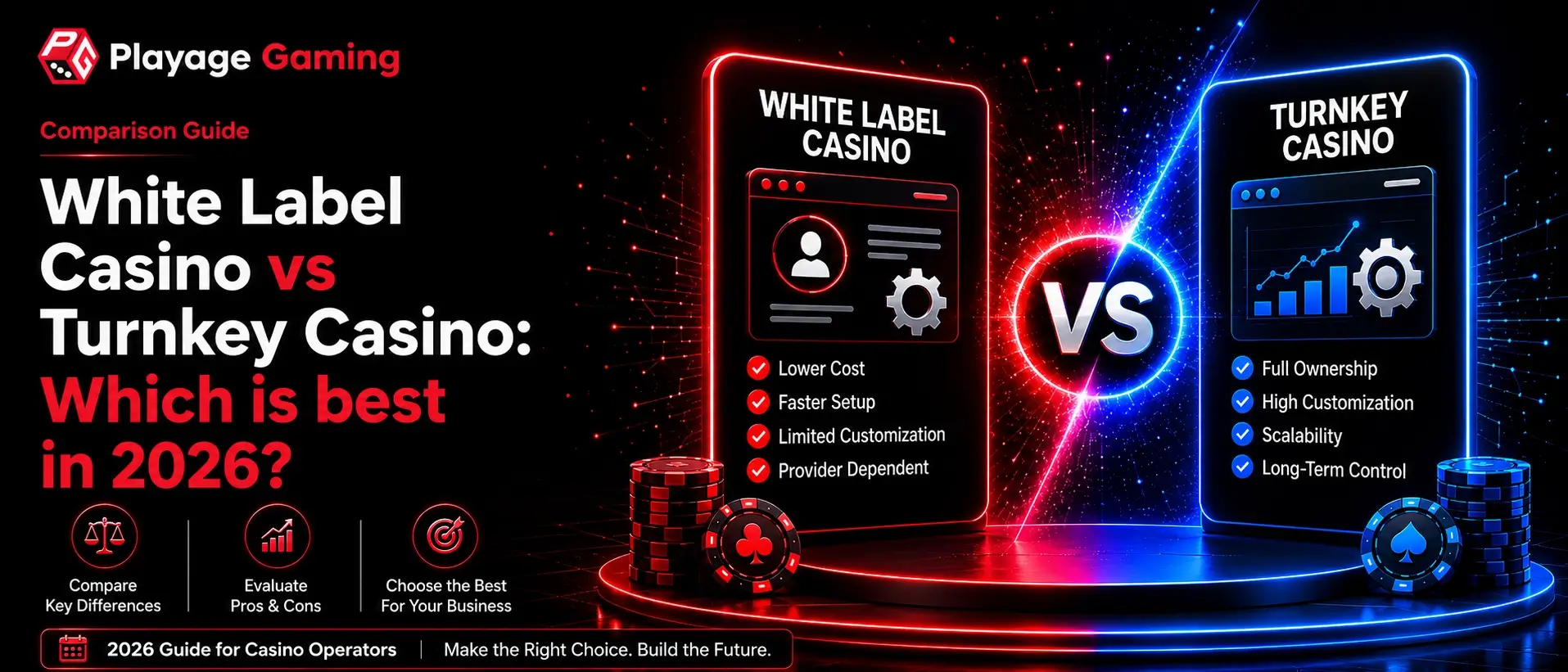
In 2026, the worldwide online wagering market is projected to be in between $120 to $143.7 billion, growing at a compound annual growth rate (CAGR) of 10%. Looking ahead, the global online gambling market is projected to expand to $170.8 to $212.44 billion by 2030, maintaining a CAGR around 10.4%.
There are several factors that contribute to this growth. Mobile devices now account for more than 53% of all iGaming traffic. But with all these, rules and regulations are also getting stricter year by year in Europe, North America and Asia-Pacific.
For new entrepreneurs and operators entering this booming industry, there's one decision that needs to be made first. It is a choice which you have to make even before you release your first game, before your first player registration, and even before you receive your first dollar.
And that question is, Do you need to start with a turnkey casino solution or a white label casino platform?
At first glance these two models appear to be alike. Both allow you to launch a branded online casino without having to build or develop technology from scratch. However, they are very different under the surface and result in distinct business outcomes. They are different in terms of ownership rights. They have different revenue structures. They offer various types of market access. Which over time form completely different financial circumstances.
In this guide, we will break down the specific differences between the two models in detail, based on the data for 2026. At the end, you will know which is the best model for your iGaming business.
Quick Definition
What Is a Turnkey Casino Solution?
A turnkey casino solution is a completely pre-built, launch-ready iGaming platform that is delivered to you as a complete package and for which you have full ownership. In this the provider is responsible for building and configuring the whole platform.
This includes game integrations, payment systems, back-office tools, CRM systems, compliance infrastructure, and the user interface. Once all things are set up properly, then the provider hands over complete control to you as the operator.
The term turnkey is no coincidence. Instead it means you turn the key and the business is yours to operate.
The main difference which makes turnkey fundamentally different from white label is ownership. With a turnkey solution, you own these things:
- All source code rights and the platform codebase
- Your own gaming license from your chosen jurisdiction
- All player accounts, data and behavior history.
- All your bank accounts and any and every payment provider relationship
- Complete control of which game providers you integrate.
- Full control of your target markets and geographic access.
There is a widespread misunderstanding of turnkey solutions that needs to be cleared up. Turnkey isn't something about creating a casino from scratch. A good turnkey provider, such as Playage Gaming, offers a pre-built, tested, and integrated platform, meaning there is no need to put in the effort needed to set up a new site. It's not custom development. You are getting a fully functional, ready to use platform from day one.
Generally, the turnkey setup fees, provided by specialist companies, begin at 30,000 euros in 2026. Revenue share deals vary from 0-5 percent, or flat licensing fee deals with 0 percent revenue share altogether.
Explore how Playage Gaming's turnkey casino platform is structured for operators who want full ownership and control from day one.
And if you're new to the concept of turnkey platforms, begin with our beginner's guide: What Is a Turnkey Casino Solution? A Complete Beginner's Guide.
What Is a White Label Casino Platform?
A white label casino platform is an already developed, fully functional online casino framework to which you simply have to add your brand, license, and market it as your own.
In this the provider is responsible for everything under the hood. This includes the technology, the gaming license, the payment accounts and the compliance infrastructure.
However, the front end is branded with your name, logo, and colours. Once everything is set up, then you're just dedicated to marketing and player acquisition.
Here is what the provider manages on your behalf:
- The platform, maintenance and uptime
- Gambling licence and regulatory compliance
- All game integrations from their preselected game library
- Payment processing through their list of approved payment service providers
- The implementation of KYC (Know Your Customer), AML (Anti-Money Laundering) and Responsible Gambling tools.
- All technical changes and security measures
This is what you, as the white label operator, are responsible for:
- Your brand name, logo and domain name
- Marketing, and traffic acquisition
- Relationship management with players in the provider's tools.
- Making payments of your revenue share and related fees.
The white label model is best for new players who want to get to market as quickly as possible. The setup period takes between 1 to 2 weeks. And the initial expenses range from about 10,000-20,000 euros.
But there are some limitations to the speed and simplicity of white labels. These limitations are not always made clear at the beginning. As your business expands, they add up in a big way. Each of them will be explored in this guide.
In 2026, the white label casino solutions industry had a market value of 667.20 million dollars. According to 360iResearch (2026), it is expanding at a 9.05 percent annual rate and will reach 1.12 billion dollars by 2032. The model is expanding. But it is also becoming more restricted in its regulations.
Turnkey vs White Label Casino: The Core Differences
| Feature | Turnkey Casino Solution | White Label Casino Platform |
|---|---|---|
| Platform Ownership | Full. The code and platform are owned by you. | The provider keeps all essential assets. |
| Player Data Ownership | Player data is 100% owned by the operator. | The player database is owned by the provider. |
| Revenue Model | Revenue share 0-5% or fixed license fee. | Ongoing net revenue of 15-40% of gross gaming revenue. |
| Cash Flow Control | All accounts and payments are under your control. | The remaining portion is paid to you, with the payments retained by the provider. |
| Time to Launch | With a modern provider, 4-6 weeks. | 1-2 weeks. |
| Setup Cost (2026) | 30,000 to 500,000+ euros depending on scope. | 10,000 to 50,000 euros upfront. |
| Customization | Unlimited. Design, user experience, features, game library. | Template-based branding only. |
| Game Library | Select any providers and aggregators as per your wish. | Only available through provider's pre-integrated selection. |
| Payment Methods | Support any payment service provider, local and crypto. | Only pre-approved provider's payment list. |
| Licensing | Your own license. An actual asset that can be sold. | Sub-license under provider's master license. |
| Geographic Market Access | Full control. Select target markets on your own. | Limited by the jurisdiction of the provider's license. |
| Scalability | Unlimited. Add a sportsbook, new verticals. | Limited by provider's ecosystem and roadmap. |
| Switching Cost | Easy. You are the owner of the platform. | Very high. Requires complete rebuild. |
| Long-Term Business Value | Builds equity. A platform is a business asset that can be sold. | No equity built. You're simply leasing hardware. |
| Tier-1 Regulated Markets | Fully accessible (MGA, UKGC, Isle of Man). | Blocked. White label sub-licensing is not allowed under Tier-1 licenses. |
| Best For | Scaling operators, long-term business builders. | Startups, testing the market, lean teams. |
Geographic Restrictions: The Market Access Problem
The Curaçao Problem
Most white label vendors are holding a Curaçao eGaming license. A large geographic coverage exists in this jurisdiction. But it specifically prohibits dozens of countries. When the regulator mandates that the platforms be blocked, that list changes.
More importantly: if one of the hundreds of operators running under a common master license commits to a compliance violation, then the regulators can shut down the entire country's markets. All operators under the same license umbrella are affected at the same time.
Tier-1 Markets Are Inaccessible
The most valuable regulated iGaming markets do not allow for the sub-licensing of white label licenses. This is not permitted in Malta (Malta Gaming Authority), United Kingdom (UK Gambling Commission) and Isle of Man. This effectively prevents white label operators from entering into the most lucrative, most established and most player-focused regulated markets in the world.
| Jurisdiction | White Label Permitted? | Notes |
|---|---|---|
| Curaçao (GLB Reform 2024) | Limited | Now the sub-licensing is no longer permitted or greatly restricted; B2B license required. |
| Malta MGA | No | The use of white label sub-licensing is explicitly forbidden. |
| UK Gambling Commission | No | All individual operators must be licensed. |
| Isle of Man | No | No sub-licensing and individual licensing required. |
| Gibraltar | Limited | Strict due diligence is required and will be decided on a case-by-case basis. |
| Kahnawake | Yes | Allows sub-licensing (under conditions). |
Whereas turnkey operators choose their own licensing jurisdiction. They obtain their own license. This means they also determine their market access strategy.
Your gaming license, in a turnkey structure, is also called a genuine business asset. Because as your business expands, it can be expanded to other jurisdictions, transferred or sold.
Compliance Disclaimer: All information is subjected to change and is written in this to the best of our knowledge as of May 2026. Prior to making any licensing or jurisdiction decisions, always seek advice from a qualified iGaming legal professional.
3-Year Total Cost of Ownership: The Real Financial Comparison
| Cost Component | White Label (3 Years) | Turnkey (3 Years) |
|---|---|---|
| Setup Fee | 20,000 euros | 40,000 euros |
| Revenue Share (20% average of 2.25M gross gaming revenue) | 450,000 euros | 0 to 112,500 euros (0-5%) |
| Capital Reserve (locked capital, average 20%) | 60,000 to 100,000 euros | 0 euros |
| Gaming License Costs | Share of revenue included | 45,000 to 90,000 euros (15 to 30k per year) |
| Platform Migration (if you are changing at Year 2) | 50,000 to 100,000 euros | 0 euros |
| Payment Service Provider Fees (no negotiation ability) | Higher fixed rates | The price is negotiable, usually about 15-20% below. |
| Estimated 3-Year Total | 580,000 to 670,000 euros | 185,000 to 245,000 euros |
| Operator Keeps (GGR): 2.25M (gross gaming revenue) | 1.58M to 1.67M euros | 2.0M to 2.06M euros |
The Break Even Point:
On an industry-standard commercial terms, a turnkey operator becomes break-even with a white label around 200,000 euros of gross gaming revenues. Most growing operators achieve this within their first 6 months.
Above that point, the higher the revenue the greater the margin for the turnkey operator. The gap is compounded by itself each year.
Pros and Cons: Honest Assessment for iGaming Operators
Turnkey Casino Solution
Advantages:
- Complete control of platform, licenses and player data
- Zero or minimal revenue share. Retain most of the gross gaming revenue.
- Full design and user experience, features and integrations customization freedom
- Flexibility in integration with game providers, payment service providers, or crypto gateways.
- Full ownership of geographic targeting and access to markets strategy
- Gaming license is a tangible business asset that can be sold.
- Access to all Tier-1 regulated markets (MGA, UKGC, Isle of Man)
- Builds long-term equity. You're not renting a business, you're creating a business.
- Increased ROI when income grows over the long term
Disadvantages:
- More expensive than white label, upfront cost.
- Requires obtaining your own gaming license (time and cost investment)
- Increased operational responsibility for compliance and maintenance.
- Usually takes 4-6 weeks to go live, as opposed to 1-2 weeks for white label
White Label Casino Platform
Advantages:
- Quickest turn to market (1 to 2 weeks from contract to live)
- Low upfront cost (10,000 to 50,000 euros)
- The provider is responsible for licensing, compliance, and technology maintenance.
- No technical skills necessary for the team or employees
- Access to pre-integrated game library and payment methods
- Practical for testing out a niche or market before investing more heavily.
Disadvantages:
- 15 to 40 percent ongoing revenue share (compounding cost at scale)
- The rolling reserve ties up between 45,000 and 100,000+ euros of working capital.
- No ownership of platform, player data, or payment accounts
- Limited to provider's list of games and payment service providers.
- Geographic limitation due to provider's licence
- No ability to add custom features or independent integrations
- The turnkey migration is costly and intrusive
- Structurally prevented from Tier-1 regulated markets (MGA, UKGC)
- There is no ownership in business. The platform and license cannot be sold.
The Hybrid Approach: Start White Label, Scale to Turnkey
When does migrating make sense?
The trigger points that normally indicate that you are ready to move from white label to turnkey are:
- The monthly gross gaming revenue is regularly between 50,000 and 100,000 euros. At this point, revenue share is a costly proposition.
- You are looking to enter the MGA/UKGC regulated markets.
- To compete with the established brands, your brand needs to differentiate in terms of user experience.
- You're looking to have your player database and behavior.
- You are thinking about launching a sportsbook, live casino, or other verticals
The migration process, what operators need to know:
- As soon as possible, 6-9 months prior to the expected migration date, apply for your gaming license. The critical path is the licensing timelines.
- Before signing your white label contract, negotiate a player data portability clause. A lot of providers won't transfer your player data when you are leaving them. If you lose that database, it's a problem.
- Choose a turnkey provider that provides dedicated migration support and parallel-run.
- Schedule for parallel operation window. Operate both platforms for a short time to maintain continuity with players.
- Budget realistically for migration. A full transition is in the range of 50,000 to 100,000 euros+ which is normal.
The operators who get this transition right are the ones who thought about it first before going live on white label, and not afterward.
2026 Technology Trends: How AI and Crypto Are Reshaping the Decision
AI-Powered Player Management
By 2026, AI-powered personalization, prediction of customer churn, and behavior analytics have become essential differentiators. These features are not a special advantage anymore.
In fact, it is clear that operators leveraging AI for retention have seen significant improvements in customer lifetime value and reductions in churn rates compared to those with traditional manual CRM processes.
Turnkey operators have the freedom to integrate, customize, and iterate AI tooling. While white label operators are completely reliant on the AI development roadmap of their provider. Still most providers are yet to bring any real AI functionality to the operator level.
Playage Gaming's turnkey platform comes with a native AI Chat module and a dedicated Churn AI system. These are available for all our turnkey operators without third party dependency or integration work.
Crypto-Ready Payment Infrastructure
In 2026, the demand for crypto payments has reached unprecedented levels. Such growth is fueled by the mainstream adoption and player expectations for quick and seamless withdrawals without the hassle of borders. Nowadays, most markets expect Bitcoin, Ethereum, USDT, and new Layer-2 tokens.
Turnkey operators can integrate any crypto gateway or Web3 wallet easily. Whereas white label operators only offer the crypto rails which their provider approves. And It usually takes 12-18 months for provider approvals to keep up with market demand.
Playage Gaming's turnkey casino and sportsbook platform includes 100+ payment methods. This includes major cryptocurrencies as well. They are built-in and ready to use from Day One of your online casino venture.
Mobile-First Architecture
In the current landscape, over 53 percent of global iGaming revenue comes from mobile and tablet devices according to Mordor Intelligence, 2026. As stated by Voluum, this number is increasing by 13.65 percent annually through 2031. Players are looking for a mobile experience that's as native as possible, not a responsive desktop template.
Turnkey operators manage all aspects of the mobile user experience. While white label operators work within provider-approved templates. They are not able to create their own mobile experiences or native apps on their own.
Regulatory Technology (RegTech) Compliance
Today, in all major regulated markets, AML automation, real-time KYC verification, responsible gambling tools, and player protection reporting are standard compliance expectations.
Turnkey operators have control on their own compliance stack. Where they are able to audit, update and certify their processes autonomously.
While White Label operators rely on the compliance infrastructure provided by the provider. They are not able to independently provide regulatory compliance to Tier-1 authorities.
Which Model Is Right for You? The Decision Framework
| Your Situation | Recommended Model | Reason |
|---|---|---|
| An operator for the first time, a budget of less than 20,000 euros. | White Label | Lowest barrier; test the market first. |
| With a budget of over 40,000 euros and a plan of 2 years and upwards. | Turnkey | Design for scalability from day one. |
| When aiming for MGA markets, UKGC or Isle of Man markets. | Turnkey only | Structurally, white labels are not allowed. |
| Looking for a fast and easy way to test one niche geographic market. | White Label | The trade-offs are acceptable with regards to speed and cost. |
| Planning to add both casino and sportsbook | Turnkey | Full control is needed for multi-vertical architecture. |
| Revenue share is becoming a margin concern | Turnkey | At scale, revenue share will be a painful issue. |
| Must launch within 2 weeks | White Label | Quickest route to live operations. |
| Establishing a business that you plan to sell or grow | Turnkey only | Turnkey builds are the only ones that transfer equity. |
| Want to own your player data | Turnkey | White label providers are the owner of the database. |
There are 6 questions you must ask yourself before selecting a provider:
- 1What is the realistic revenue goal you see for your gross gaming revenue in 36 months?
- 2What markets and jurisdictions do you want to target?
- 3Do you have or are you preparing to get your own gaming license?
- 4How much platform customization does your brand need to become competitive?
- 5Will you look to venture into sportsbooks, live casinos or other verticals in near future?
- 6How much revenue share are you willing to accept on an ongoing basis as your revenue grows?
If you're considering running a casino and a sportsbook under one roof, check out how Playage Gaming's sportsbook is a turnkey solution that can operate within a single operating dashboard.
How Playage Gaming Fits Into This Picture
Playage Gaming is a turnkey iGaming platform provider, specifically designed for those operators who prefer full ownership but without the usual difficulties and expense of turnkey providers.
Our turnkey platform tackles the two basic factors that have always motivated an operator to choose white label over turnkey: speed and simplicity.
But with Playage Gaming's turnkey platform, there is no need to choose a white-label alternative and lease a platform at the sacrifice of owning your business.
The Playage Gaming turnkey platform includes the following:
- Over 35,000 games from more than 100 trusted suppliers. No entity or aggregator to share revenue with for game content.
- 200 plus payment methods. This includes local payment rails, fiat money and cryptocurrencies. All pre-integrated.
- Full back-office suite. This includes customer relationship management, affiliate management, content management system, bonus engine, and multi-currency support.
- AI-powered tools. This includes predicting churns natively and using AI chat for player retention.
- Single dashboard control. Control all the operational aspects from the same interface.
- Zero percent revenue-sharing arrangement. The gross gaming revenues go 100 percent to you.
Excited to discover what possibilities exist for your operation? Get a customized quote from the Playage Gaming team.
Schedule a Free ConsultationWhat is the main difference between a turnkey and white label casino?
A turnkey casino provides operators with complete ownership of the platform, gaming license, player data and cash flow. Whereas, in operating a white label casino means the operator is running a brand with the provider's license and infrastructure, without the permission to export players data. The provider does not take responsibility for the brand and marketing in both, but why market a business which is not truly yours. With complete ownership turnkey builds long term equity. White label does not.
Conclusion
The turnkey casino vs white label casino isn't just a question of speed or control. It is a choice concerning which sort of iGaming company you are developing. It decides whether your business will be yours or not.
For operators with a small capital base, a way to test the market is through the white label route. It is accessible due to its speed as well as its low entry cost. It's useful for operators testing a concept prior to making a big investment.
But, the facts are obvious. White labels are hugely expensive as revenue grows. The revenue share is compounded. The rolling reserve grows. You are limited in expansion by the geographic restrictions. The Tier-1 markets, the ones where the top-tier players are, are forever off-limits.
In comparison, turnkey operators are building equity every month that goes by. They run their own platform, their own players, their own payment relationship and their own license. They get in the market when they want to. They maintain the margin white label operators give up to providers.
The turnkey model is the structure that makes it possible for you to build an iGaming business that will be able to grow, compete, and create lasting value.
Excited to see what a fully integrated platform can do for your business? Get a free, no-obligation quote from the Playage Gaming team.
Need to ask questions about the platform? Contact us directly. We are available to operators, from pre-launch planning through to full scale operations.
Disclaimer: Playage Gaming only provides iGaming platform technology to Licensed iGaming Platform Operators and business entities for B2B use. All of the iGaming activities must be carried out within the legal framework and regulatory standards of the relevant jurisdiction. This article is intended for information purposes only. It is not meant as legal, financial or regulatory advice. Before starting an online gambling business, always seek the advice of qualified legal and compliance experts.
Related Posts
What Is a Turnkey Casino Solution? A Beginner's Guide
Understand what a turnkey casino platform includes, who it is for, and why operators choose it over building from scratch.

How to Start an Online Casino in 2026: A Complete Step-by-Step Guide
A complete step-by-step guide covering licensing, platform selection, budget, compliance, technology and market entry for launching an online casino in 2026.
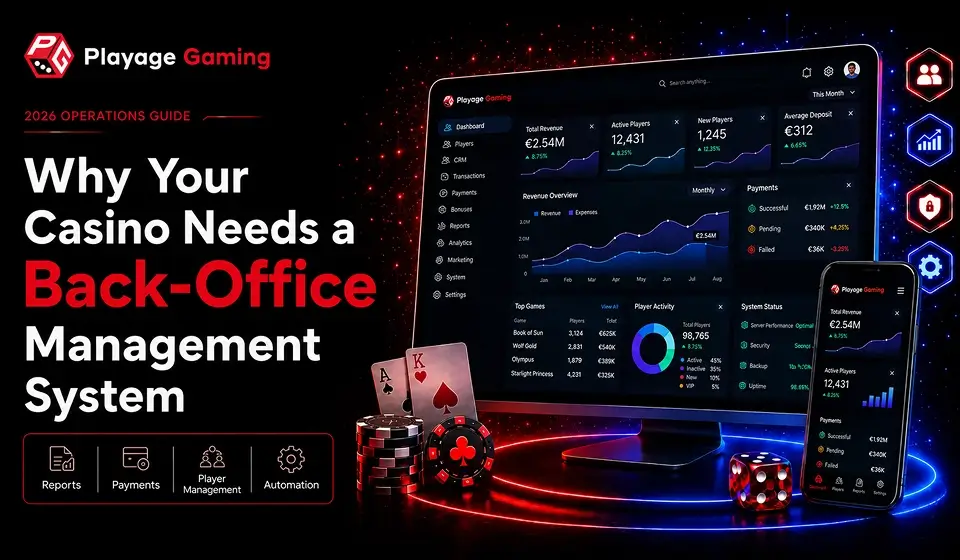
What is a Back-Office Management System and Why Does Your Casino Need One?
Understand what a casino back-office management system is, what it includes, and how it directly drives player retention, compliance, and long-term revenue.
