How Much Does It Cost to Launch an Online Casino in 2026?
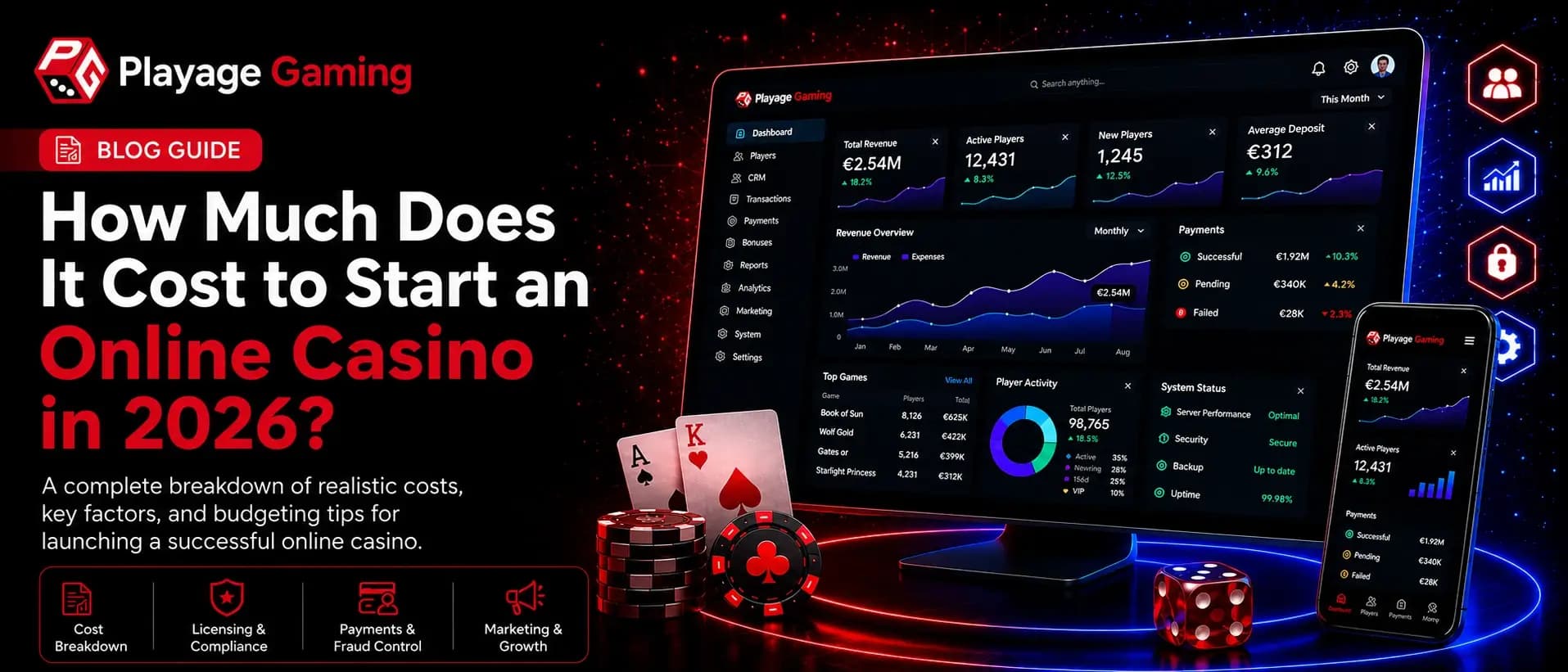
Launching a white-label online casino in 2026 can cost anywhere from €10,000 for a basic white-label setup to more than €30,000+ for a turnkey solution, and over €300,000+ for a custom multi-market operation.
The honest answer is that the cost to start an online casino depends less on the website design and more on four decisions that an operator needs to make:
- 1Which regulated markets are you planning to enter?
- 2Whether you will be using a white-label, turnkey, or custom platform.
- 3How your platform will manage payments, fraud, and player withdrawal reserves.
- 4Whether you have enough money to operate responsibly after launch.
Low-cost online casino launches look good on paper, but they are not. Because an online casino is not only a website, it's a regulated FinTech business that needs to protect customer funds, due diligence, KYC standards, fraud prevention, marketing partner operations, and gambling regulations.
Industry benchmarks vary widely. Online casino software development costs anywhere from €10,000 to more than €3,00,000 based on the platform selected and required complexity & compliance needs as estimated by Playage gaming.
What is the cost of a new online casino in the business year 2026?
A basic white-label casino solution starts from €10,000 with profit sharing and goes above €30,000 with profit sharing, depending on markets and what features they are offering.
A Turnkey solution costs between €30,000 and more than €100,000, depending on the market, license, and features.
A custom casino platforms range from €80,000 to more than €200,000. This totally depends on your developers, licenses, and market.
Do remember that in a custom solution, the final amount is not clear as it totally depends on licensing cost, tax, payment provider integration, game suppliers, KYC, and AML checks.
This guide walks you through what those numbers actually consist of, where operators often understate costs, and how to build a more realistic launch schedule.
Important note: This article is for business planning only. Gambling laws, licensing requirements, tax treatment, and marketing rules vary by jurisdiction. Obtain advice from qualified legal, tax, and compliance professionals before accepting players in any market.
Why Is There No Fixed Cost To Launch An Online Casino?
Whenever a new person wants to start their own online casino, they want to know how much it will cost to open an online casino.
In the casino industry, mainly the pricing depends on your model:
Casino with operators branding but operating under another company's licence, basically a white-label solution.
A business using a ready-made casino solution with its own licence, payments, customer support, and compliance team, like Turnkey Casino software.
A custom-built casino company serving multiple regulated markets has its own development team, customer support, and compliance team.
Points that add up to your final amount:
- Launch cost means the money needed before going live.
- Operating cost means the recurring monthly spend after launch.
- Working capital means available cash for player withdrawals, payment delays, supplier invoices, marketing, and unexpected costs.
- Gross gaming revenue, often called GGR, is the amount staked by players minus the winnings paid to them.
Before finalizing any solution, you should consider all these factors and then go ahead with your decision. Successful operators are clear about which solution they should go with before even getting 1st quote.
If you are still in confusion, then you can connect with our team, and we will surely guide you on which solution you should go with.
The Three Main Online Casino Business Models
White-Label Online Casino
A white-label online casino is a solution in which an operator gets a ready-made platform to launch within a few days. Operators can change the front-end according to their brand color and logo.
Everything is provided by the provider from front-end to back-end, and even license infrastructure as well.
Anyone who is looking to start their own online casino can start with a white-label casino, but before finalizing, make proper calculations for at least a year or two.
A white-label provider may include:
White-label providers mostly charge a setup fee, a monthly minimum guarantee fee (depending on the provider), and a fixed percentage anywhere between 20%-40% (depending on the provider). Some providers also charge a mix of three, while others charge at least a setup fee and any of the one option from the other two options.
Typical white-label online casino cost
| Main cost area | Indicative budget |
|---|---|
| White-label platform setup and branding | €10,000 to €30,000+ |
| Monthly platform / managed service fee | €1,000 to €10,000+ per month |
| Revenue share to provider | 10% to 40% of NGR/GGR |
| Launch marketing and affiliates | €25,000 to €150,000+ |
Note: These prices are an average figure and not exact. It changes according to provider, region, and features. In the future, these prices may vary.
A realistic first-year budget for a white-label online casino operator is usually around €80,000 to €250,000+.
A White-Label Casino is suitable for:
- Operators who are just entering into running their online casino and want to experience it with a low budget.
- Affiliate businesses that want to try launching their own casino brand.
- Companies without an internal tech team to build each and everything from start.
- Existing operators who want to try a new market.
- Businesses that need speed rather than custom software ownership.
Here are some questions you should ask your provider before signing the agreement:
- Who owns the player database?
- Who controls customer funds and withdrawals?
- Which markets are explicitly permitted?
- The casino will be operated under which sub-license?
- What revenue share applies?
- Is there a minimum monthly commitment?
- Can I export my player database if I want to leave?
- Who is responsible for anti-money laundering controls?
- Who manages responsible gambling tools?
- What happens if a payment provider withdraws support?
A cheap provider can become expensive if the contract limits your ability to move, scale, or retain customer ownership.
Turnkey Online Casino Platform
In turnkey casino platforms, an operator gets everything from the provider, like a game library with thousands of games, to multiple payment methods, front-end tools, and back-end tools.
Turnkey Casino is also known as a ready-made casino solution, plug-and-play casino software, all-in-one casino platform, and full-stack iGaming platform.
For example, if you bought a white-label solution from a provider and then buy another turnkey solution, you will get the same product.
The main difference is that in white-label, you don't have full control, whereas in turnkey solutions, you get full control of everything.
A turnkey casino platform offers an operator a higher degree of control compared to an outsourced or white-label solution.
The core platform comes from the technology provider, but compliance, payments, marketing player support, and market entry rest on the operator.
Typical turnkey casino launch cost
| Cost area | Indicative budget |
|---|---|
| Platform setup and configuration | €20,000 to €120,000 |
| Gambling licence preparation and legal support | €30,000 to €200,000+ |
| Game content, integrations, and testing | €25,000 to €100,000 |
| Payment processing and reserve funds | €50,000 to €250,000 |
| Website design and localisation | €25,000 to €75,000 |
| Compliance, verification, and fraud tools | €25,000 to €100,000 |
| First six months of operations | €75,000 to €300,000 |
| Initial player acquisition budget | €75,000 to €500,000+ |
Note: These prices are an average figure and not exact. It changes according to provider, region, and features. In the future, these prices may vary.
Estimated turnkey casino cost for the first year: €200,000 to €400,000, with higher budgets required for tightly regulated markets.
Though a turnkey solution looks a bit more expensive at the start, it is more affordable for an operator who wants to stay for a long time. It also provides full ownership.
A Turnkey Casino Solution is suitable for:
- Operators who want to launch quickly with full ownership.
- Startups that do not want to build the platform from scratch.
- Companies without an in-house tech team.
- Affiliate businesses that want to start their own online casino brand.
- Existing operators testing a new market.
- Startups that don't want to connect multiple APIs for everything.
Here are some questions that you should ask your provider before signing the agreement:
- What is included in the turnkey package?
- Is there a setup fee, monthly fee, or revenue share?
- Who handles KYC, AML, and responsible gambling?
- Who manages payment providers and game suppliers?
- What support, maintenance, and updates are included?
- Which game providers are included by default?
- Can I request additional game suppliers later?
- Can I add or remove payment providers if needed?
A turnkey solution is one of the fastest ways to launch, but the real value depends on how much control you have, whether full ownership is with you, and how much flexibility the contract gives you.
Custom Online Casino Software Development
Custom Online Casino Software Development is way different than the white-label and turnkey, as in this operator does not deal with any provider; instead, they hire a development team that develops a casino from zero according to their business model, target market's regulation policies, and other custom needs.
A serious custom project can include:
Playage gaming estimates that more advanced online casino platforms can exceed €100,000 to €500,000 Euro in development cost alone.
And this figure does not include licensing, payments, marketing, staffing, player reserves, or multi-market compliance. With this, the overall price increases more.
Custom platform budget
| Cost area | Indicative budget |
|---|---|
| Discovery, architecture, and product design | €50,000 to €150,000 |
| Core casino platform development | €100,000 to €800,000+ |
| Compliance, security, and testing | €75,000 to €250,000 |
| Supplier integrations | €20,000 to €200,000 |
| Data, reporting, and customer tools | €20,000 to €200,000 |
| First-year technical maintenance | €100,000 to €300,000 |
| Licensing, operations, payments, and marketing | €250,000 to €1 million+ |
Note: Prices may vary in the future and under different circumstances.
Estimated custom online casino cost: €750,000 to €1.5 million or more.
A custom platform makes sense when an operator has a proven model, huge funding, a product that differentiates itself from the market, a product marketing strategy, and a clear reason why not to depend on a turnkey or white-label platform.
What Does the Cost for an Online Casino Actually Include?
The first major expense is the license. And this is also one of the most misunderstood.
New operators think that getting a gambling license means you get permission to operate in any market. But it is not, because a license that supports one jurisdiction may not allow the operator to operate in the other market.
The cost of a licence can include:
- Application fees.
- Annual renewal fees.
- Corporate structure costs.
- Legal and compliance advice.
- Key-person checks.
- Technical testing.
- Audit preparation.
- Required local offices or representatives.
- Tax and regulatory reporting.
- Ongoing responsible gambling and anti-money laundering obligations.
Top Licensing Jurisdictions
UK Gambling Commission (UKGC)
The UK Gambling Commission, also known as UKGC, is the body responsible for providing a remote casino operation license to operators who want to offer casino games in the Great Britain region through a website or mobile phone.
This license is mainly important when an operator wants to build a casino brand from one of the most trusted gambling markets in the world.
Due to a large number of players, the UK has some rules and regulation which an operator needs to add to the casino from the start.
Like operator needs to confirm players' age, player protection, include responsible gambling tools, proper reporting, complaints handling, payment checks, and an internal compliance staff.
Though the UK market is attractive, it needs a strong launch budget to start operating in the UK and a more serious operating plan.
Malta Gaming Authority (MGA)
The Malta Gaming Authority, also known as MGA, provides a B2C Gaming Service Licence when a Maltese or EU/EEA entity wants to offer gaming services from Malta to a Maltese person, or through a Maltese legal entity. It is often considered by operators who want a recognised base for a Europe-facing casino business.
The Malta Gaming Authority, also known as MGA, provides a B2C gaming license to operate an online casino in Malta to serve Maltese persons or serve as a Maltese legal entity.
The main value of an MGA license is not just market entry. It acts as a credible source for operators in front of banks, payment providers, game suppliers, and business partners. This is also one reason operators choose an MGA license.
Like other gambling license providers, MGA also has its own rules and regulations, such as proper company structure, your platform should have Player account management and player protection measures, have AML rules, and many more rules.
Curaçao Gaming Authority (CGA)
The Curaçao Gaming Authority, also known as CGA, now regulates the online gaming industry in Curaçao under the recently implemented National Ordinance on Games of Chance, also known as LOK.
This makes Curaçao very important for operators who want an international casino licence from a known offshore gaming jurisdiction.
Curaçao is usually reviewed by startups, crypto casino brands, and international operators who want to test a wider market without starting in a very strict local jurisdiction. Its main role in a cost plan is speed, structure, and supplier access.
However, the operator still needs to check where players can legally be accepted, which payment providers will support the business, and whether the platform setup matches the new Curaçao rules.
Isle of Man Gambling
The Isle of Man Gambling Supervision Commission, also known as the Isle of Man GSC, regulates the gambling companies on the Isle of Man and is known for online gambling supervision.
Operators usually consider this licence when they want a stable business base with a strong reputation for governance and player protection.
This licence is especially useful for operators who are thinking beyond the launch stage.
For example, if the business wants better payment confidence, clean reporting, strong fund controls, and a professional corporate structure, the Isle of Man can become part of the planning.
It is not only about getting permission to operate. It is about building a casino company that banks, suppliers, and partners can take seriously.
Gibraltar Remote Gambling Licence
A Gibraltar Remote Gambling Licence is used by operators that want to run remote gambling operations from Gibraltar.
Under Gibraltar’s gambling framework, all gambling operations in Gibraltar require licensing under the Gambling Act 2005. This makes it a serious option for remote casino and betting businesses.
Gibraltar is usually not the first choice for a very small experiment. It is more relevant for operators with a mature business plan, proper management, strong compliance preparation, and a long-term market view.
Many established betting and casino groups have considered Gibraltar because it gives the business a respected European-facing base. For cost planning, it belongs in the category of serious operator setup, not basic entry-level launch.
Alderney Gambling Control Commission
The Alderney Gambling Control Commission, also known as AGCC, provides a recognised eGambling framework.
One useful point about Alderney is that its Category 1 model focuses on player management, including player registration, while gaming activity can be supplied through a Category 2 platform or another competent platform.
This licence is useful when an operator wants to separate the business model more clearly.
For example, the operator can think about who manages the players, who provides the platform, where the games are hosted, and how player funds are handled.
This makes Alderney interesting for brands that want a structured operating model rather than a simple all-in-one launch package.
Kahnawà Gaming Commission
The Kahnawà Gaming Commission, also known as KGC, is connected with interactive gaming activity from the Mohawk Territory of Kahnawà.
One key authorisation is the Casino Software Provider Authorisation, which allows approved interactive gaming equipment to be located at an approved co-location facility and software to be licensed to third-party operators.
Kahnawà is different because hosting and interactive gaming infrastructure are a major part of the structure.
This can suit operators who want a North American-linked gaming setup and want to plan around hosting, software approval, player protection, and operational control.
Factors to consider while selecting a gambling license
While choosing a license for your online casino, you should not check which is cheapest; instead, there are more factors that you should consider before inquiring about any license you need:
- Which countries or regions can we target legally with this license?
- Does this license match our long-term goals and expansion plan?
- What tax structure applies to the market we want to enter?
- What compliance architecture will we need to follow after the launch?
- What KYC, AML, and responsible gambling systems are required?
- Which payment providers and banking solutions support this licence?
- Which game suppliers and software providers work with this jurisdiction?
- What technical standards, audits or platform requirements must be completed?
- What reporting and monitoring obligations will the operator need to manage?
- Does this licence require a local company, representative or specific business structure?
- How will this licence affect our brand credibility with players and partners?
- Will this licence support future products such as sportsbook, crypto payments or multiple casino brands?
A cheaper licence can become more expensive if it does not support the markets, banking relationships, payment methods, or supplier partnerships your business requires.
A Practical First-Year Online Casino Budget Model
First-Year Budget Formula
First-year funding requirement = launch costs + operating costs + marketing spend + player reserves + contingency fund
For planning purposes, include an emergency fund of at least 15% to 25%.
Example: Lean white-label casino launch
| Budget category | Example budget |
|---|---|
| Brand, website, and content | Approx €25,000 |
| White-label setup | Approx €15,000 |
| Legal and compliance preparation | Approx €25,000 |
| Payment and verification setup | Approx €20,000 |
| Initial player reserve | Approx €50,000 |
| Six months of operational spending | Approx €90,000 |
| Six months of marketing | Approx €120,000 |
| Contingency fund | Approx €60,000 |
Note: Prices may vary in the future and under different circumstances.
This may sound higher than a basic platform quote. That is the point.
The platform fee is not the business cost.
Example: Regulated turnkey casino launch
| Budget category | Example budget |
|---|---|
| Licence application and legal support | €100,000 |
| Turnkey platform and integrations (if the provider does not allow games, payments, or backend tools) | €60,000 |
| Payments, verification, and fraud | €75,000 |
| Player withdrawal reserve | Depends on your monthly revenue |
| Six months of operations | €200,000 |
| Six months of marketing | €300,000 |
| Emergency fund | Depends on you |
Note: Prices may vary in the future and under different circumstances.
This model is not suitable for every operator. It demonstrates why a well-regulated, properly funded launch can require seven-figure capital.
The prices mentioned above are not related to us or any particular provider; the prices used above are average industry standards. As time passes, the prices can go above and below as well.
How to Reduce Online Casino Launch Costs Without Creating Risk
First and foremost. Start with one defined market. Do not launch in multiple markets at once. Translating the content is an easy task, but following the rules and regulations of each country can make your team's work difficult.
That is why you start with one market where you understand:
- Licensing requirements.
- Payment preferences.
- Player behaviour.
- Tax exposure.
- Marketing restrictions.
- Local competition.
- Customer support needs.
Create a proper product roadmap. Launch with the essential product first. Add advanced features after the business has reliable data.
Negotiate commercial terms carefully. Ask suppliers to clarify:
- Setup fees.
- Minimum monthly fees.
- Revenue share.
- Exit fees.
- Data ownership.
- Service-level commitments.
- Technical support hours.
- New market fees.
- Payment provider obligations.
- Game supplier minimums.
Avoid unnecessary custom development. Custom development is valuable when it creates a real competitive advantage.
It is not valuable when it simply recreates a standard casino feature that a stable provider already supplies.
Protect the withdrawal reserve. Never reduce the player reserve to pay for a larger launch campaign. Player trust is more valuable than a short-term marketing spike.
Common Mistakes When Estimating the Cost to Start an Online Casino
Treating the licence as the full compliance budget
Understanding that the application fee is the only thing in the compliance budget is a mistake made by new operators. Compliance requires people, a proper system, regular records, training, reviews, and ongoing monitoring.
Assuming crypto removes financial controls
Adding crypto payment methods adds an extra layer of security and trust, but it does not mean that you have removed payment and compliance risks. There are risks of money laundering, fraud, and consumer protection. That is why we add AML tools and comply properly with license rules and regulations.
Choosing a provider only by setup price
Many new operators who have a low budget usually choose a provider with a low setup fee. But with low setup fees, there are high chances of hidden fees like high revenue share, poor data portability when you want to move, slow payment support, restrictive market access, and more.
Underfunding customer support
To reduce the operating cost, many operators integrate AI chatbots and remove real customer support. Do remember that players remember how easily their issues are solved, especially those related to withdrawal, verification, and payment methods. And these sectors can not be left to AI.
Ignoring tax in market selection
Tax is one of the important things to consider while selecting a market. Ignoring this affects most of the profits.
Launching before payment capacity is proven
Testing is one of the most important things to consider before the launch. Many operators just believe the testing report that the provider gives. But testing from the player side is not performed. An operator can do testing by giving early access to some of the players, like friends and family, to test each and everything. Because many times payment is working fine in development, but as soon as it goes live, the error occurs, and this affects players' experience and trust.
When Does an Online Casino Break Even?
There is no guaranteed timeline.
Break-even depends on:
- Acquisition cost.
- Player retention.
- Average deposit value.
- Bonus cost.
- Game supplier revenue share.
- Payment costs.
- Tax.
- Fraud losses.
- Customer support costs.
- Compliance costs.
- Platform fees.
- Withdrawal behaviour.
A business should not assume profitability in its first month.
A more responsible approach is to create three financial cases:
- Conservative case: slower acquisition, lower retention, higher costs.
- Expected case: realistic targets based on comparable markets.
- Downside case: payment disruption, regulatory delay, higher fraud, or weak conversion.
The downside case is the most important. It shows whether the business can continue operating responsibly when results are weaker than planned.
How PlayAge Gaming Can Help You Launch
The above-mentioned are the solutions; here are the products you get with each of the solutions:
- 20,000+ casino games
- 100+ payment methods including crypto
- Casino CRM with AI Churn to improve retention
- CMS with AI frontend builder and 100+ ready-made casino templates
- Affiliate management panel
- Business panel
- Backend panel
- AI Chatbot
A realistic budget starts at roughly €80,000 Euro to €250,000 Euro for a carefully limited white-label launch. A standalone turnkey casino can require €250,000 Euro to €750,000 Euro, while a custom or multi-market online casino can cost €750,000 Euro to more than €1.5 million.
How much does it cost to start an online casino?
A realistic budget starts at roughly €80,000 Euro to €250,000 Euro for a carefully limited white-label launch. A standalone turnkey casino can require €250,000 Euro to €750,000 Euro, while a custom or multi-market online casino can cost €750,000 Euro to more than €1.5 million.
Conclusion
The real answer to “how much does it cost to open an online casino?” will never be a fixed number.
As it totally depends on your selection, if you go with a white label provider, the setup cost will be low, but if you are planning to operate a white-label casino for a longer period, then you are paying 20-45% of your profits to the platform provider monthly and also give GGR, so you are paying more than a turnkey casino solution in the longer run. And then also there is no fixed cost; the setup cost and the profit percentage vary by provider, features, and market.
If you go with Turnkey Solution. Then the setup cost is more than the white-label provider, but you don't have to provide any profits to the provider; you have to pay a fixed GGR, and also some providers take a monthly fee. Rest, everything is yours. With this, you can recover your initial investment quickly and move forward to a successful casino journey.
Whereas, in a custom solution, you have access to everything, but do remember with custom solution also you have to partner with game providers or aggregators, and payment providers. And create other tools by yourself or partner with 3rd party providers for that too. This is costly in both ways, time and money. But you have full control over everything.
Do remember that instead of choosing a provider based on price will become the decision you will regret in the future as an operator.
Instead, go with a provider who is providing thousands of games, multiple payment options, other tools like CMS, CRM, Affiliate Management, Backend Panel, and, more importantly, AI tools like AI Chatbot and Churn AI.
Will definitely be a better option for an operator as he does not need to partner with any 3rd party providers then.
You can reach out to the Playage Gaming Team to know how we can help you with your Online Casino Journey from zero to one. With our extensive experience, we are able to help operators who are confused about choosing between the type of platform and which market to choose. Schedule a meeting or drop your inquiry; we are always there to help you.
Related Posts
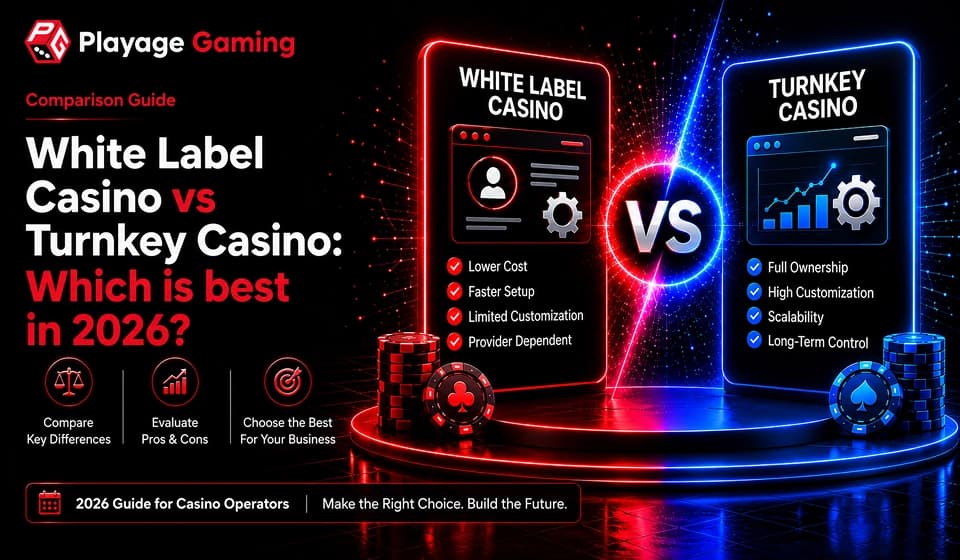
White Label Casino vs Turnkey Casino: Which is best in 2026
Understand the real differences between white label and turnkey casino models, including costs, ownership, market access, and which one is right for your iGaming business in 2026.

How to Start an Online Casino in 2026: A Complete Step-by-Step Guide
A complete step-by-step guide covering licensing, platform selection, budget, compliance, technology and market entry for launching an online casino in 2026.
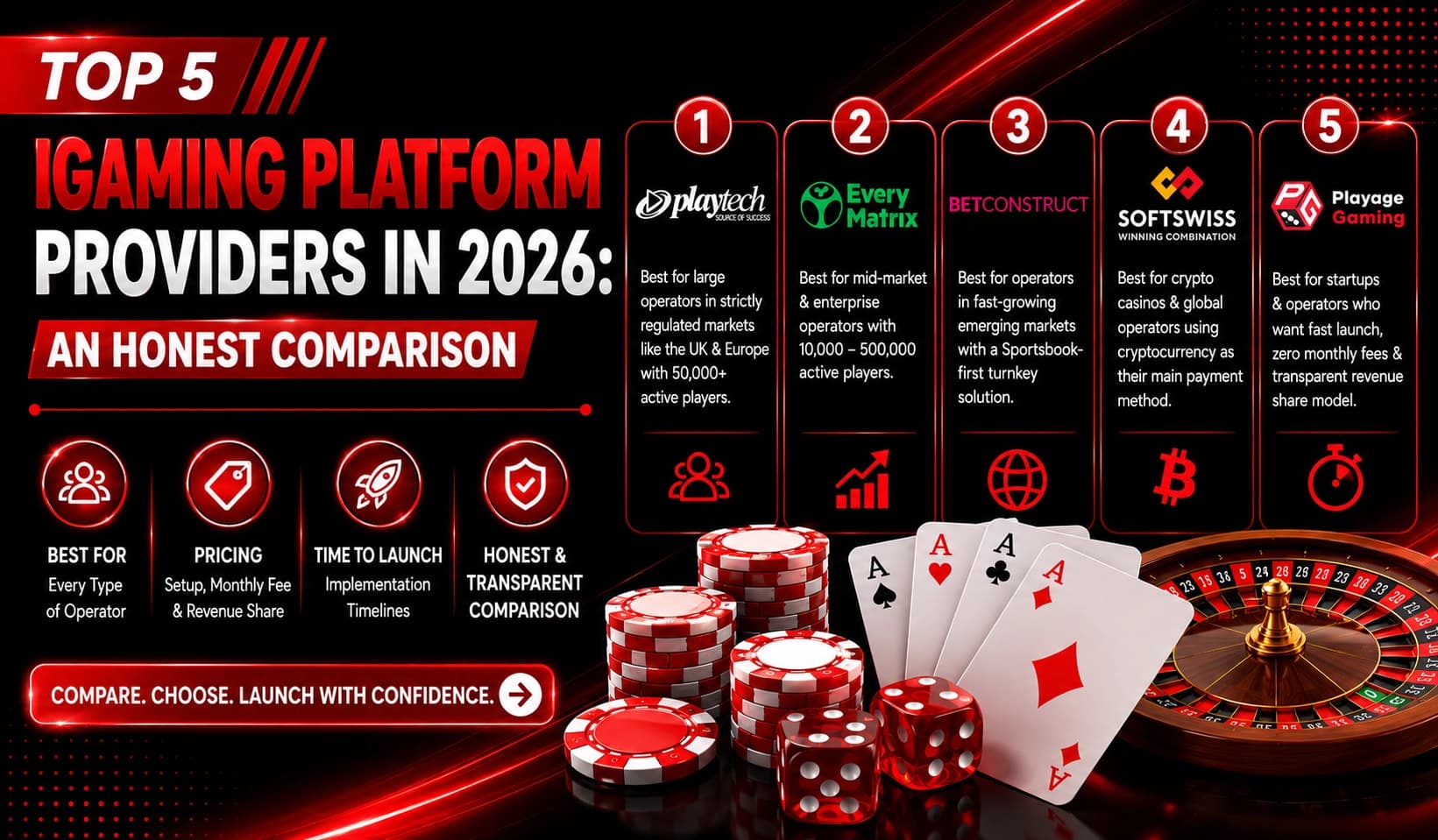
Top 5 iGaming Platform Providers in 2026: An Honest Comparison
An honest, no-fluff comparison of the top 5 iGaming platform providers in 2026 - Playtech, EveryMatrix, BetConstruct, SoftSwiss, and Playage Gaming. See real setup costs, monthly fees, revenue share, game libraries, compliance coverage, and a 3-year cost breakdown to help you choose the right partner.